
Ellicott City Resident Lookup Records
Ask the question before touching a keyboard. An Ellicott City resident lookup only works when the record type matches what you actually want to know. A recorded owner is not always the occupant. A docket entry proves nothing beyond the docket. A directory listing is just a dated listing, so a second source should back any historical claim. Because Ellicott City has no municipal custodian for these materials, Howard County and Maryland state agencies supply the practical routes.
| Record | What It Confirms | Where | Access |
|---|---|---|---|
| Parcel and assessment | Recorded owner field, parcel, legal description, and transfer context | SDAT Real Property Search | Public informational search; no general owner-name route located |
| Deed index | Grantor, grantee, instrument date, book, and page relationship | Maryland Land Records | Account, multi-factor authentication, and portal terms apply |
| Court index | Party, case number, court, type, filing date, and docket route | Maryland CaseSearch | Public index with CAPTCHA; restricted cases are omitted |
| Estate index | Decedent, estate status, representative, and filing trail | Howard Register of Wills | Free index; copies and certification go through the office |
| Vital route | Event and relationship evidence when the requester qualifies | Maryland vital-records guidance | Eligibility, ID, fees, and archival thresholds control |
| License or entity record | Regulatory status or a business filing, not a residence | Maryland Business Express | Public fields vary; confirm the status date and source |
Match the tool to the job. Reach for a parcel or land record only when an address or instrument clue is already lawfully known. CaseSearch fits a defined case question. EstateSearch fits probate research. A license or entity entry shows an affiliation or filing status rather than where a person lives, and the State's voter self-service tool belongs to the voter instead of any public residents directory.
Set an Ellicott City Lookup Question
Write things down before searching. Record the full name as supplied, spelling variants, an approximate year, and a lawfully known address or ZIP code. Add the record type you want. That habit separates very different relationships: recorded party, docket party, historical listing, licensee, or business representative. It also lowers the risk of merging two people who share a name.
Historical questions need a date range first. Keep the source date beside each result. Go to the official custodian, not a copied list. The safe sequence runs question, custodian, available fields, access condition, result type, then a verification step. Skip the open-ended profile hunt. A no-result screen is not proof a person is absent from the records.
Note: One official index can list a person while another omits them entirely, because each record serves a different purpose with different coverage.
CaseSearch for an Ellicott City Resident
Maryland Judiciary CaseSearch is a docket index, not a residents directory. It generally needs an exact name. The system accepts % as a partial-last-name wildcard and runs a CAPTCHA. Narrow by Howard County, court, case type, and filing date. Repeatedly broadening a common name rarely pays off. The Howard County courts directory gives the local court route. Stated online coverage begins April 23, 1997 for Howard Circuit civil cases. Coverage for criminal cases starts May 4, 1999.
| CaseSearch field | How to use it | Limits |
|---|---|---|
| Party type | Choose person or business before entering a name. | It identifies a docket role, not a residential relationship. |
| First, middle, last name | Use the available spelling and test a limited last-name wildcard. | Similar names need a court, year, or case-number check. |
| Court system and county | Select the Circuit or District route and Howard County when appropriate. | Coverage varies by court and case category. |
| Case type and filing date | Use civil, criminal, traffic, or civil citation with a defined date range. | Broad searches can reach the 500-result cap or time out. |
| Court and case number | Use the secondary search when a defined case number is known. | A number does not override a seal or confidentiality rule. |
A single result can carry a case number, party name, court, case type, filing date, caption, and details like attorneys, scheduling, judgments, documents, and service. Dates of birth may appear where the court shows one. Copy only what the question needs. Sealed, expunged, juvenile, and adoption matters stay confidential. Those cases are not ordinary public results.
Ellicott City EstateSearch Details
EstateSearch generally covers 1998 forward, with some older material, and it updates daily. For heirs and probate, the Howard County Register of Wills is the local entry point for Ellicott City estate research. It can trace an estate trail. It cannot prove an unstated family tie. Ask about older files, copies, or certification.
- Decedent
- The person whose estate is indexed. Use spelling variants carefully and keep the date range narrow.
- Estate number
- A specific estate identifier. The official search recognizes an exact 12-character number.
- Status and dates
- Estate status, date of death, and date filed help distinguish similarly named decedents.
- Representative, attorney, alias, and docket
- Searchable index fields that can point to the correct proceeding, not an instruction to compile personal contact details.
The index caps results at 500 and supports last-name wildcarding along with date ranges. A precise estate number makes the best handoff.
Verify an Ellicott City Resident
Anchor one limited fact first, then corroborate it. A deed links names to an instrument. A court result links a party to a case. Neither establishes current occupancy in Ellicott City. For historical family or property questions, combine two sources whose dates and record roles fit together, and state plainly what each source supports.
- Choose a defined question, such as whether a named party appears on a particular parcel record, court case, or estate file.
- Search the official index with the name variant, date, county, parcel, court, or record number that fits that question.
- Compare the result with a second source, keeping the record dates and source roles separate.
- Request a copy or certified copy from the actual custodian only when the official record, rather than the index entry, is needed.
- Docket
- The court’s running case record, showing events and filings associated with a case.
- Index versus image
- An index helps locate a record. An image is the scanned or filed document, which may have a different access rule.
- Certified copy
- A copy authenticated by the custodian for a purpose that requires official certification.
Ellicott City Voter Tool Limits
The Maryland Voter Services search exists so a voter can check their own registration and election details. It asks for first and last name, date of birth, and ZIP code. A middle initial and street number are optional. Results may show registration status, polling place, precinct, districts, local board, and ballot information. It is not a public name directory. Do not use it to build lists of people.
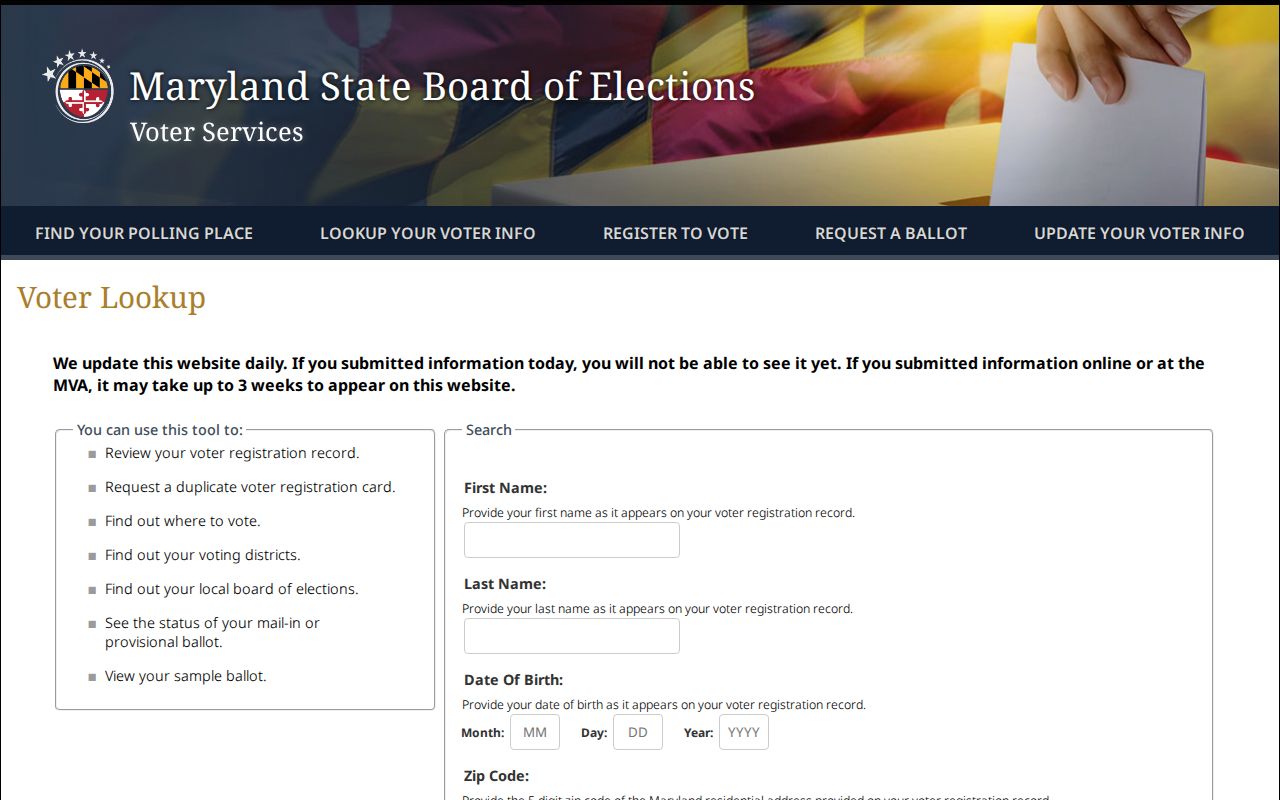
The image shows the self-service fields on the State’s official voter search. A formal voter-list request follows a separate route under Election Law §3-506: a qualified Maryland voter must use the form, take the required oath, and follow the stated use and distribution restrictions. Protected voter records can be withheld.
Vital Records for Ellicott City Research
Certified birth and death records for Ellicott City come from the Maryland Department of Health's Division of Vital Records. That office also handles certain marriage and divorce routes. Anything older may sit at the Maryland State Archives instead. Which office holds the record depends on the event type and its date. Certified copies follow agency eligibility and identification rules. A divorce decree stays with the Circuit Court even where the State offers verification.
Archival rules treat Maryland births under 100 years as restricted under State Government §9-1015. Deaths under 10 years are restricted too. Older birth and death records, marriage licenses, and absolute-divorce or annulment reports may be open at the Archives. Still, an individual file can contain medical or other confidential material. Check the State Archives death-record guidance or the Department of Health's live forms rather than assuming any certificate is public.
Note: A vital record proves an event or relationship only within its stated scope. A certificate request never bypasses eligibility rules.
Ellicott City PIA Request Route
The Maryland Public Information Act, General Provisions §§4-101–4-601, applies when a record is not online. It gives you a request route. Ask the custodian for an existing, defined item. Name the agency. Identify the record or series, and supply a date range or a case, parcel, or instrument number. State your preferred format too. A request for every record about a person demands a new analysis. It will likely be called overbroad.
Timing and cost have known limits under the Attorney General's PIA guidance. A response is generally due within 30 days unless a special reason applies. If more than 10 working days are needed, you get a written estimate or reason. The first two hours of search and preparation are generally free. Reasonable actual costs can follow, with a possible waiver under §4-206. Court, vital, and Archives copies carry their own access and certification rules. Check each one before relying on a single PIA request for an Ellicott City records pull.
Ellicott City Record History
Ellicott City's county-seat history explains why one person search can cross several custodians. Howard County did not always exist as such. Before its formation, Howard District material stayed with the Maryland State Archives. The Archives still preserve it. County land records begin in 1851. The Howard District grantor index reaches back to 1840 and runs through 1851. For an older instrument, the Archives' Howard County land-record series is a quick jurisdiction check.
Ellicott's Mills became Ellicott City under the 1867 Act cited by the Archives. A historical place label does not make a modern record or mailing address identical, though. Many older sources are scanned paper indexes, microfilm, or finding aids. They are not complete text databases. That record history matters for an Ellicott City residents directory. An empty name search can call for the right series or date range instead of a broad new sweep.
Legal Limits on a Resident Lookup
Public records are not an invitation to collect or republish everything visible. Maryland agencies apply record-specific redactions, eligibility requirements, and reuse rules. The Maryland Safe at Home Address Confidentiality Program gives an eligible survivor of domestic violence, human trafficking, sexual assault, or stalking a substitute address. It is free. It does not erase an address already public. It also does not automatically revise every county record.
Covered voters can ask the State Board of Elections for nondisclosure of residential address information in specified election records. Email and phone information can be shielded too. A correction to an agency record belongs with that agency's written correction process. For land-record functions, contact the Howard Circuit Court's Land Records Department directly. Do not ask a general residents directory to change the official source.
Lawful use. Use Ellicott City record sources for personal, lawful research. Maryland’s stalking and harassment laws prohibit using found information to stalk, harass, intimidate, or harm another person.
When an Ellicott City Lookup Ends Empty
A blank result in an Ellicott City resident lookup can mean many things. Spelling, coverage, a date boundary, or a confidential record can all produce nothing. An index may not even search the field you expect. CaseSearch has its own quirks: it can time out after about two minutes. It also caps results at 500. Narrow the court, case type, filing range, and exact name before treating the gap as real. A courthouse visit or a written request may be the next route for a defined case item.
Older Howard land research has a firm boundary. Howard County land records begin in 1851, while the Howard District grantor index covers 1840–1851. The Maryland Land Records redesign added an account and multi-factor-authentication gate in 2025. Some older scanned indexes need browsing rather than text search. Save the query date, source URL, coverage statement, and result type so the next check is reproducible without exposing private details.